METLIFE (MET)·Q4 2025 Earnings Summary
MetLife Beats EPS by 24% YoY, Achieves All New Frontier Targets
February 5, 2026 · by Fintool AI Agent
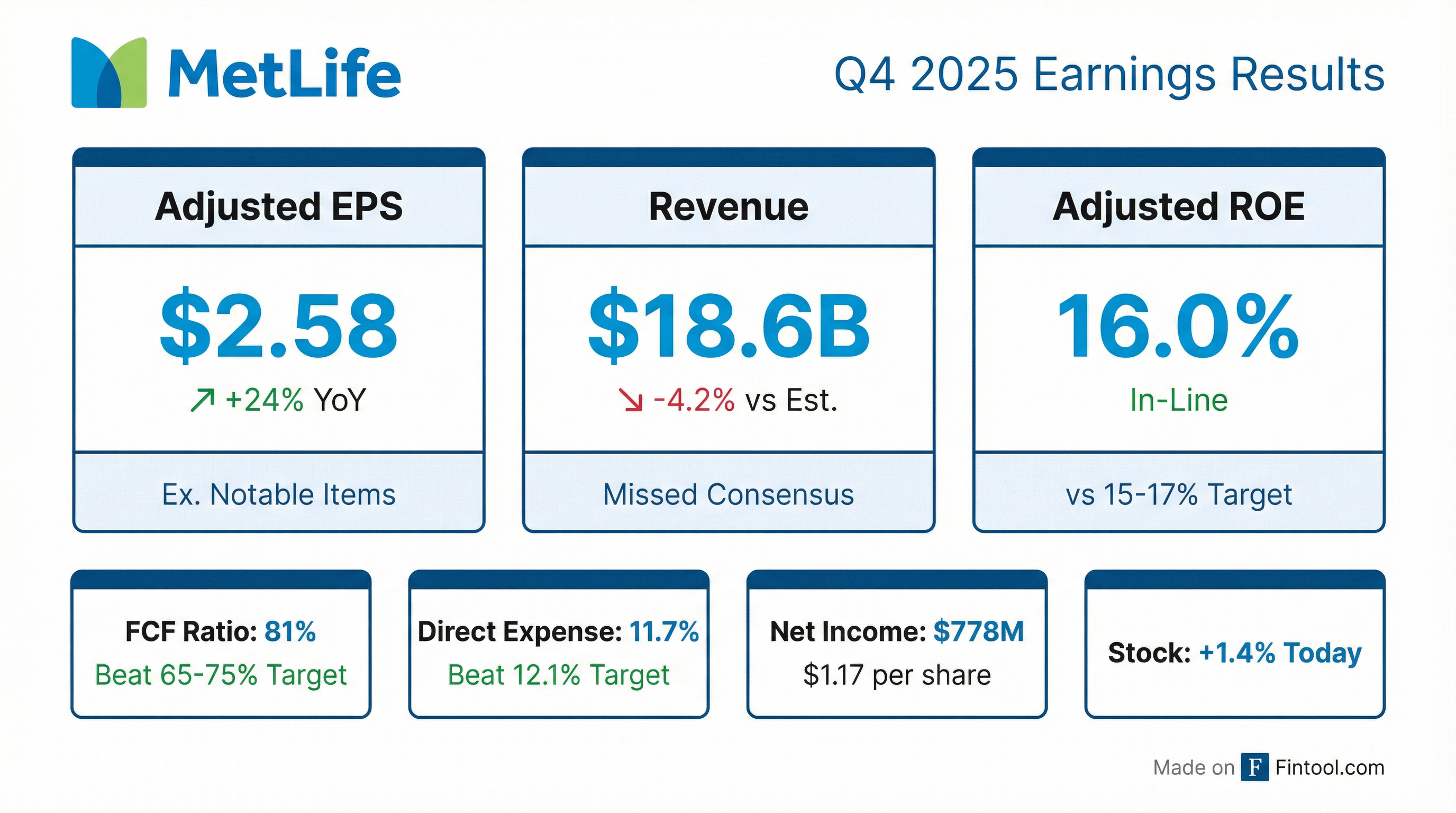
MetLife delivered a strong close to 2025, reporting adjusted earnings of $2.58 per share (excluding notable items) — up 24% year-over-year — while achieving all four of its New Frontier financial commitments. The results were driven by broad-based segment strength, with every business unit except Asia showing double-digit growth.
The headline: MetLife hit double-digit adjusted EPS growth (10% for FY25), a 16% adjusted ROE within its 15-17% target, an 81% free cash flow ratio exceeding the 65-75% target, and a direct expense ratio of 11.7% beating the 12.1% target.
However, revenue missed consensus by approximately 4.2%, which may explain the muted stock reaction despite the strong earnings beat.
Did MetLife Beat Earnings?
Yes on EPS, no on revenue. MetLife beat adjusted EPS expectations but missed on the top line.
*Values retrieved from S&P Global
The difference between net income and adjusted earnings was primarily attributable to net derivative losses from higher interest rates ($646M post-tax) and net investment losses ($160M post-tax), partially offset by market risk benefit remeasurement gains.
For the full year 2025:
- Adjusted EPS (ex. notable items): $8.89, up 10% YoY — achieving the double-digit growth target
- Adjusted ROE: 16.0%, within the 15-17% target
- FCF Ratio (2-year avg): 81%, exceeding the 65-75% target
- Direct Expense Ratio: 11.7%, beating the 12.1% target
 Ask Fintool AI Agent
How Did the Stock React?
MetLife shares closed at $78.01, up 1.44% on the day. After-hours trading showed the stock at $77.02, down 1.3% from the close — a muted reaction despite the strong EPS beat.
*Values retrieved from S&P Global
The lukewarm reaction may reflect the revenue miss or already-elevated expectations heading into the print given strong Q3 results.
What Drove the Beat?
Segment Performance
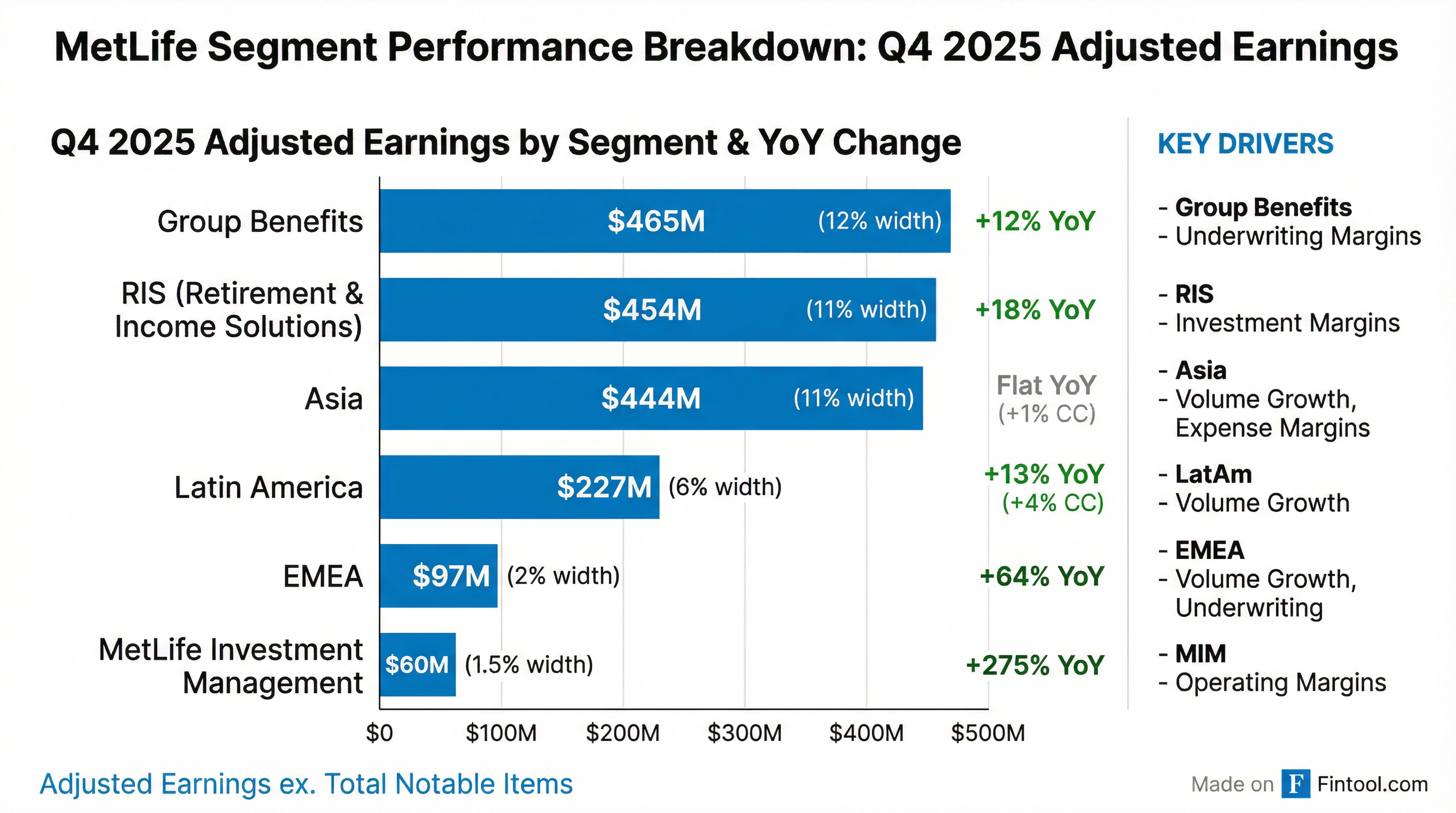
All segments except Asia delivered double-digit growth, with MIM and EMEA being standout performers:
Variable Investment Income Above Guidance
Q4 2025 VII came in at $497M for private equity alone, above the $425M quarterly target — driven by stronger-than-expected PE returns.
FY 2025 VII of ~$1.5B pretax came in slightly below the ~$1.7B guidance but well above prior year.
Cash & Capital Position
MetLife remains strongly capitalized with robust liquidity:
Ask Fintool AI AgentWhat Did Management Guide?
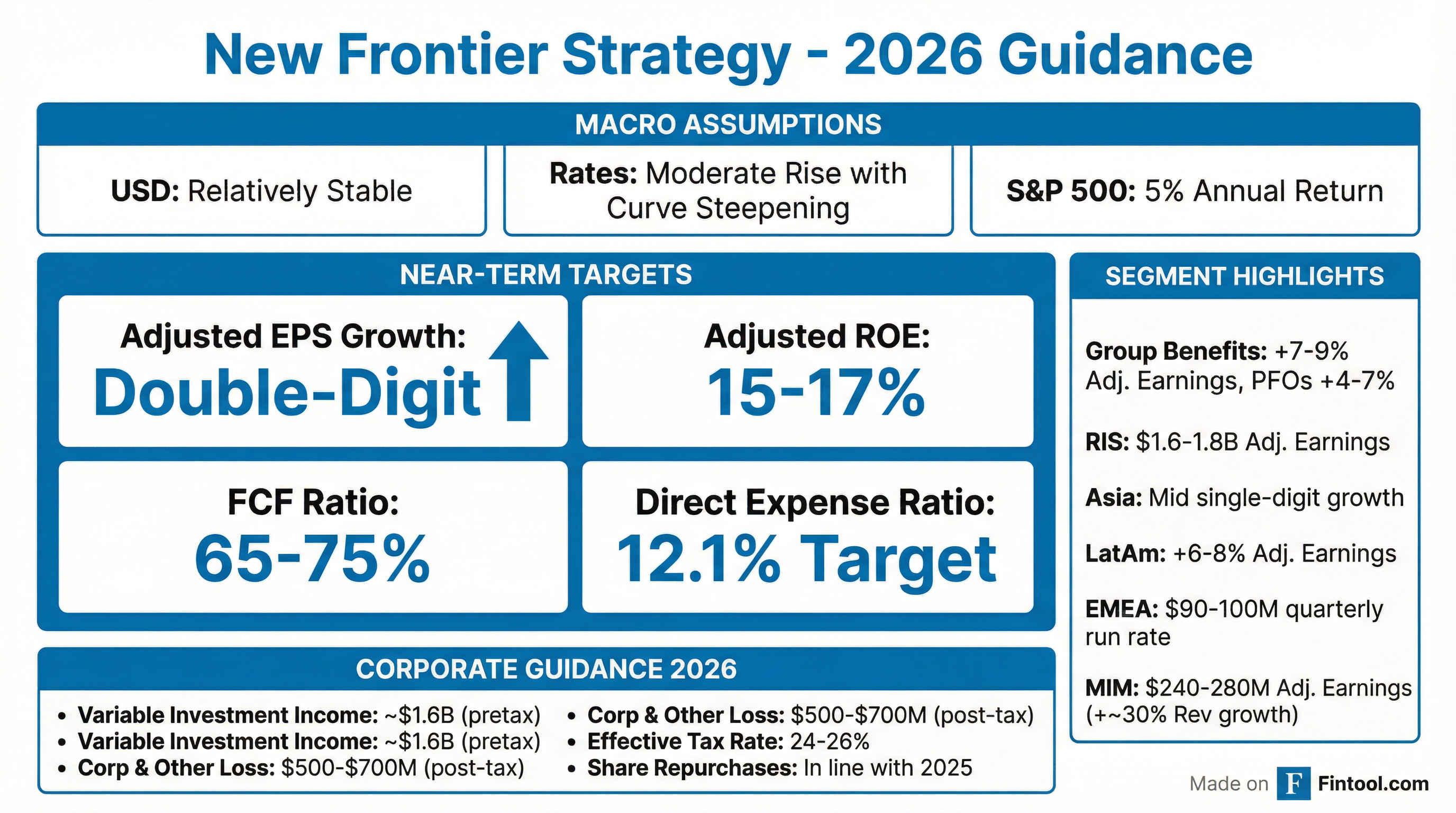
MetLife provided comprehensive 2026 guidance aligned with its New Frontier strategy:
Corporate Guidance for 2026
Macro Assumptions
- U.S. Dollar relatively stable vs 2025
- Long-term interest rates moderately rise with yield curve steepening
- S&P 500 annual return of 5%
Segment-Level Guidance
Interest Rate Sensitivities
What Changed From Last Quarter?
The most significant change was the surge in adjusted EPS (+28% QoQ) driven by strong underwriting margins in Group Benefits and investment margins in RIS. The lower net income reflects derivative losses from interest rate movements.
Commercial Mortgage Loan Portfolio Update
MetLife highlighted the quality of its CML portfolio:
- Average LTV Ratio: 68%
- Average DSCR: 2.1x
- 77% of portfolio with LTV ≤80%
- 93% of portfolio with DSCR ≥1.0x
- Office exposure: 80% average LTV, 1.9x average DSCR
Forward Estimates
*Values retrieved from S&P Global
Q&A Highlights
The earnings call Q&A surfaced several important themes:
Group Benefits: Strong Start to 2026
Management reported robust Q1 2026 results for renewals and persistency. On dental specifically, after repricing actions in Q1 2025, persistency has improved significantly.
"If we look at our Q1 results, in particular with respect to persistency and renewals, we're seeing pretty robust results. I would say increase in persistency, in particular in dental... we also have good sales growth across our book of business, and in particular, I would highlight disability here as an area of strength." — Ramy Tadros, Group Benefits
Disability: Q4 Weakness Not a Trend
Q4 disability results came in below expectations due to higher average severity and lower Social Security decisions. However, management cautioned against extrapolating:
"While this has been an unfavorable quarter, it certainly does not make a trend, and I wouldn't extrapolate from the outcomes in this quarter into 2026." — Ramy Tadros
Key factors: Long-term disability severity up, Social Security decisions down (quarter-to-quarter fluctuation), recoveries slightly lower but strong for full year.
Japan: FX Volatility Manageable
Despite dramatic moves in yen/dollar rates and Japanese interest rates, management remains confident in Japan's outlook. Surrender trends were slightly higher in Q4 due to yen depreciation, but full-year 2025 surrenders came down vs. 2024.
"We're very optimistic about our position in Japan and optimistic about our potential in going into 2026... our sales results have been very strong this year. They've been up 17%." — Lyndon Oliver, Asia
For 2026, surrenders are assumed to return to long-term assumptions.
Paid Family Medical Leave: Bundling Success
MetLife is leveraging state PFML mandates as an anchor product, with impressive attach rates:
"When I look at our one-on-one sales for PFML, on average, they came with four or five additional coverages that were bundled with those sales." — Ramy Tadros
AI Impact: Minimal Workforce Concerns
When asked about AI disrupting employment (and thus Group Benefits), management noted they've incorporated employment actions into their outlook and maintain a diversified book across industries, employer sizes, and geographies.
U.S. Retail Retirement: New Flow Reinsurance
MetLife has executed two flow reinsurance deals with partners to participate in the fast-growing U.S. retail annuity market on an institutional basis:
"In under a year, we executed against that strategy. We now have two partners with flow reinsurance deals in place that have kicked off over the past couple of months." — Ramy Tadros
Brighthouse/Aquarian: Modest Risk
Asked about Brighthouse's pending acquisition by Aquarian and potential MIM impact, management noted the relationship is valued but diversification limits exposure:
"At the end of the day... this would be, you know, a worst-case scenario, would, you know, at the end of the day, would be a very modest impact to EPS." — John McCallion
Real Estate Accounting Change
MetLife revised its adjusted earnings definition to exclude non-cash real estate depreciation, adding ~$200M annually (mostly to Corporate & Other). This better aligns book value changes with earnings and reflects recurring cash flows.
Ask Fintool AI AgentKey Risks and Watch Items
- Revenue trajectory: Q4 missed consensus; need to monitor if this persists
- VII volatility: ~$1.6B 2026 target assumes PE returns at lower end of 9% range initially
- Mexico VAT: ~$50M headwind to LatAm in 2026, mostly H1
- Interest rate sensitivity: 50 bps decline would reduce earnings by $38M in 2026
- MIM integration: PineBridge and Mesirow acquisitions need successful integration
- Real estate exposure: Office CML portfolio remains a watch item despite strong metrics
- Disability trends: Q4 weakness bears monitoring despite management confidence
- Japan surrenders: FX volatility could drive short-term customer behavior changes
The Bottom Line
MetLife delivered exactly what management promised under its New Frontier strategy: double-digit EPS growth, strong ROE, exceptional free cash flow, and continued expense discipline. The 24% YoY jump in adjusted EPS (ex. notable items) was driven by broad-based segment strength, with MIM (+275%) and EMEA (+64%) leading the way.
The revenue miss and muted stock reaction (+1.4% regular, -1.3% after-hours) suggest investors may be waiting for proof that 2026 guidance is achievable. With management guiding for another year of double-digit EPS growth and maintaining ~$2.9B in buybacks, the setup looks favorable — but execution in the first half will be key given VII assumptions and Mexico VAT headwinds.
Ask Fintool AI AgentData sources: MetLife Q4 2025 Earnings Presentation , MetLife Q4 2025 Earnings Call Transcript , S&P Global consensus estimates. Analysis as of February 5, 2026.